GuidesEngland
Recycling on construction sites
Last reviewed 25 October 2026
A site cabin and a welfare kitchen in England follow the same workplace streams as an office: food waste if you produce it, paper and card, dry recycling, and general waste. Rubble, plasterboard, asbestos and other construction wastes are a different duty. This guide does not cover them.
The cabin and the skip are not the same
Welfare facilities produce the workplace streams. Tea bags and leftover food are food waste. Drawings and cardboard are paper and card. Bottles and cans may be collected together. The skip for bricks and timber is arranged under the construction waste rules, with its own transfer note and its own carrier.
The England date uses the business’s full-time-equivalent staff. A short site does not create a new staff total. Record the site address you are working at when the bins are there.
What to keep apart
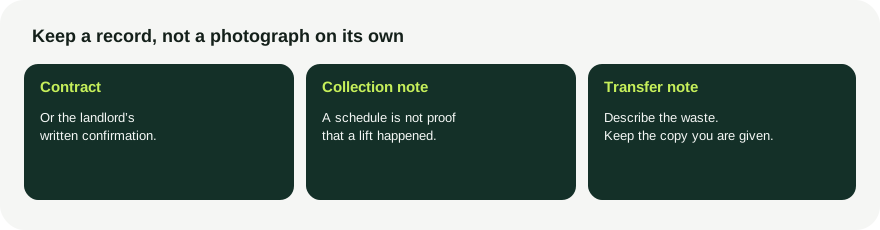
Do not put food waste or paper into a mixed construction skip and call it recycling. Do not put hazardous waste into SortProof’s ordinary streams. Keep the workplace collection contract, and keep the construction transfer notes with the project file.
If the site is in Wales, Scotland or Northern Ireland, read the guide for that nation. The streams and dates there are different. The free check on SortProof uses the England rules.
In short
- Record the welfare site separately from the construction skip.
- Separate food waste, paper and card, and other dry recycling from general waste.
- Keep construction and hazardous waste on their own paperwork.
- File the workplace contract and the project transfer notes.
- Use the nation guide if the site is not in England.
Questions
Does this guide cover plasterboard or asbestos?
No. Those are specialist construction wastes. Use the carrier and the paperwork that apply to them.
The main contractor provides the bins. What do we keep?
Keep their written confirmation of the workplace streams, and the transfer notes for waste that leaves the site.
Related guides
SortProof stores the record you enter. It is guidance, not a certificate, and it is not issued by Defra or the Environment Agency.