GuidesEngland
Recycling records for cafés
Last reviewed 25 October 2026
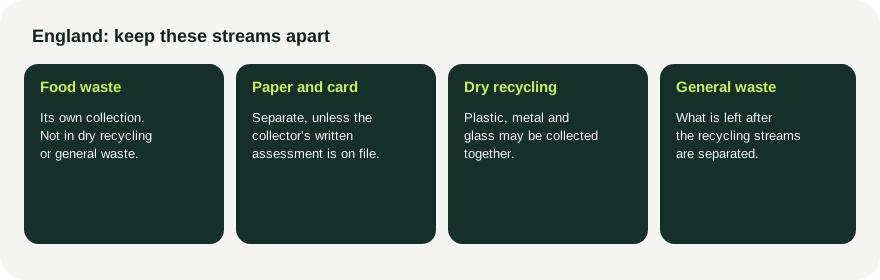
A café in England usually produces food waste, dry recycling and general waste. Coffee grounds, leftovers, tea bags and preparation scraps are food waste and stay separate from everything else. Plastic, metal and glass may be collected together. Paper and card stay separate unless the collector has a written assessment. Cups and cardboard follow that paper-and-card rule when they are paper or card.
What a café usually produces
A café produces food waste from grounds, tea bags, milk, leftovers and preparation scraps. That food waste stays in its own collection. It does not go into the cup recycling, and it does not go into general waste once the duty applies.
Plastic, metal and glass may be collected together. Paper cups and cardboard are paper and card, so they stay separate unless the collector’s written assessment is on file. Soft plastic that the collector will not take stays in general waste rather than contaminating the recycling.
Sites, landlords and the schedule
List each café as its own site, including a counter inside a shop or office. The staff total that sets the England date is still the whole business. If the landlord arranges the bins, you still separate the waste you produce and you keep their written confirmation of each stream.
A weekly plan is the schedule. It is not proof that the waste was collected, and it is not a legal number of lifts. Add a collection record when a collection happens and the paperwork is available. If the site is in Wales, Scotland or Northern Ireland, read the guide for that nation. The streams and dates there are different. The free check on SortProof uses the England rules.
In short
- List each café as its own site, including a counter inside another building.
- Record food waste, dry recycling, paper and card, and general waste separately.
- Keep a collection contract, or the landlord’s written confirmation, for each separate collection.
- Use a waste carrier you can find on the Environment Agency public register.
- A weekly or fortnightly plan is the schedule. It is not proof that the waste was collected, and it is not a legal number of lifts.
Questions
The landlord arranges the bins. Do I still separate waste?
Yes. Keep the landlord’s written confirmation of the food, recycling and general collections.
Do I need a new assessment every week?
No. The site assessment stays until the arrangement changes. Add a collection record when a collection happens and the document is available.
Where is the official guidance?
GOV.UK: https://www.gov.uk/guidance/simpler-recycling-workplace-recycling-in-england
Related guides
- Workplace recycling deadlines in England
- Paper and card at work
- Recycling records for restaurants and pubs
SortProof stores the record you enter. It is guidance, not a certificate, and it is not issued by Defra or the Environment Agency.